Mechanical Engineering study materials and notes like Fluid mechanics,thermal engineering, material science etc.

Email Subscription

Enter your email address:

Delivered by FeedBurner

Friday, April 24, 2020

April 24, 2020

screw type Compressor-working,principle!

Rotary Screw Compressor

Rotary screw Compressor are use two helical meshed rotating positive Displacement helical screws to force the air into a smaller Space.these are usually used for continuous operation is Commercial and industrial applications and may be either stationary or portabe.Due to of it's simplicity in design and few wearing parts,rotary screw air compressor are easy to install,operate and maintain.
                   Image source-gfycat.com by Google.com

Types of Rotary Screw Compressor

  1. Oil flooded rotary screw Compressor
  2. Oil free Compressor.
1.oil flooded rotary screw Compressor:-oil flooded rotary Screw Compressor are nothing but oil cooler Compressors where oil seals the internal clearances of the compressors.though filters are needed to separate the oil from the discharge air, Cooling takes place right inside the Compressor and thus the working parts never experiences extreme operating temperatures leading to prolonged life.

2.oil free Rotary screw Compressor:-It is use specially designed air ends to compress air 
Giving true oil free air .they are water cooled  and provide the same flexibility as oil flooded rotary Compressor.

Construction:-
  • Screw Compressor basically consist of two mutually engaged helically grooved rotors inside a casing.
  • One of them are male rotors consist of four lobe and it's a driving rotor.
  • And the other is female rotor consist of six gullies and it's a driven rotor.
  • These screw Compressor is coupled with an electric motor which gives mechanical rotational movement to the male rotors.
Working:-
  • When the driving rotor starts rotating along with the female rotar.then at the same time the suction end opened and the air is now starts to entrapping inside the casing .as these rotors rotate continuously the air entrapped continuously inside the casing.
  • Due to this now the air is inside the casing and both rotors rotating radially and axially with the rotation of rotars  and gets compressed due to this reduction in volume happens continuously until it reaches the discharge end.
  • As we know that the male rotors and the female rotor have different type of lobes so due to this they both rotate at different speeds.


Thank you friends for visit this website.If you like my article then Don't forget to Subscribe and do share with your friends.I Hope you all enjoy it!


Thursday, April 23, 2020

April 23, 2020

Lobe Compressor -working

Lobe Compressor

The lobe Compressor is also known as roots blower.It is essentially a low pressor blower which is used when high delivery volume but low pressure is needed.It consist of two lobes with one being driven and the other driving.the output of lobe Compressor is limited to a discharge pressure of 1 bar in a single-stage and 2.2 bar in two stage design.
                     Image souce-Commons.m 
                                           By google.com

Construction:
  • Lobe Rotary compressir consist of  two rotary lobes in which one of them are gear driven and the other is mechanical source driven.
  • It consist an air tight casing and it is designed in a way the two lobes touches the casing and makes air tight sealing at the point of contact.
Working:-
  • In this lobe Compressor,First an external mechanical energy is given to one of the rotors from an external source like electric motor.and due to this the second rotor makes gear driven from the first lobe. 
  • When motor start moving the first lobe also start moving along with the second lobe which is gear driven from the first.
  • Due to continuous moving of both lobe the air trapped inside the casing after coming from the inlet part.due to continuous moving the entrapped air is now pressurized and this pressurized air is delivered  when first and second lobe makes perpendicular at this time.the pressurized air is passed at this time to the delivery chamber.
      These lobes perpendicular to each other

Advantages-
  • It reduces life cycle cost.
  • It has high level of reliability & and long service life.
  • Pressurized air is free of oil and other absorbing material.
  • It has less maintenance requirement.
Disadvantage:-
  • It is very noisy in nature.
  • It is setup in the sound isolated room.


Thank you friends for visit this website.If you like my article then Don't forget to Subscribe and do share with your friends.I Hope you all enjoy it!
April 23, 2020

Rotary Compressor

Rotary Compressor

Rotary Compressor use rotors in place of pistons giving pulsating free discharge air.these rotors are power Driven.
                          The Compressors are not of Reciprocating nature, therefore doesn't have any pistons crankshaft.Instead of this this Compressors have screws,Vanes,Scrolls,and other devices which rotate and compress air.
              Image source-aircompressorsworks By Google.com
                             
Advantages of Rotary Compressors over reciprocating Compressors.
  • They require a lower Starting torque.
  • They give a continuous pulsation free discharge air.
  • They generally provide higher output.they are called work horses as they provide huge amount of compress air.
  • They require smaller foundations vibrate less and have lessor parts which means less failure rate.
  • They are less noisy.
  • They are much more power effective.
Classification of Rotary Compressors are:-

Thank you friends for visit this website.If you like my article then Don't forget to Subscribe and do share with your friends.I Hope you all enjoy it!


Wednesday, April 22, 2020

April 22, 2020

Indian Missiles System and classification.

Classification of Indian Missiles

On the basis of type

  • Cruise missiles:-It can flight at lower layer of the atmosphere and can hit the target accurately.
  • Ballistic missiles:-It can flight above the upper layer of atmosphere and then came towards the target due to high influence of gravity.and can hit the target accurately.


On the basis of launch mode

  • Surface to Surface missile:-It can target only surface to surface.eg:-Agni
  • Surface to Air:- It can target the missile from surface of the earth to the air.eg:-Akash
  • Air to Air:-It can hit the target from air to air.eg:-Astra
  • Air to surface:-It can hit the target from Air to Surface.eg:-Brahmos
  • Anti tank Missile:-It can prevent the tank by targetting the missile which is coming towards tank body.eg:-Nag

On the basis of Range

  • Short range:-It can target less than 1000 km.
  • Medium range:-It can target between 1000 to 3000 km.
  • Intermediate range:-It can target between 3000 to 5500 km.
  • Intercontinental range:-It can target over 5500 km.

On the basis of warhead

  • Conventional type:- This is used as oldmethod to contains high energy explosives.
  • Strategic Type:-It contains radioactive materials and can wipe off even out cities.this radioactive elements become dangerous when it be released because it makes nuclear chain reaction during nuclear fission.

Integrated Guided missile Development programme 

  • Launched in 1980
  • Completion of programme in 2008
  • Architect of this program by Dr.APJ Abdul Kalam.
  • Under this programme 5 missile are Agni,Aakash,prithvi,Trishul,Aakash and Nag.

Agni Missiles

  • Agni 1:-Its Range is about 700 to 900 km.and can carry nuclear warhead.
  • Agni 2:-Its range is about 2000 to 2500 km.and can carry nuclear warhead.
  • Agni 3:-Its range is about 3500 km. And this nuclear warhead carrying capability.
  • Agni 4:-Its range is about 5500 km. And it is nuclear warhead carrying capability.
  • Agni 5:- It's Range is about 5000 km.and this is nuclear warhead carrying capability due to this it is very destructive in nature.
  • Agni 6:- It is under development and it can be assume that range will be 5000 to 8000 km.and a new system is enhanced in it that is multiple independent reventry vehicle technique.

Prithvi Missiles

  • Prithvi 1:- It's Range is about 150 km and can carry 1000 kg nuclear Warhead.
  • Prithvi 2:-Its range is about 250 km.and carry 250 kg nuclear warhead.and it is Nuclear capable Missile.
  • Prithvi 3:-Its warhead weight 500 to 1000 kg. And range is about 350 km to 750 km.

Dhanush Missile

  • This is modification or naval version of prithvi missile .It can be used by ships.

Nag Missile

  • It is Anti tank Missile and this is fire and forget missile guided system.this can be used to protect tanks.

Nirbhay Missile

  • It is long distance subsonic cruise Missile and it is Nuclear carrying capability.its range is about over 1000 km.and it's speed is less than that of speed of Sound.

Shaurya Missile

  • It is Surface to Surface missile and it's Range is 700 to 1900 km. it is Supersonic Missile and can travel at a speed of Mach 7.5 which means grater than that of speed of sound.it is Nuclear warhead carrying capability.

Aakash Missile

  • It is Surface to air missile and it's Range is about 25 Km. It is used by Indian army as well as Indian Air Force.

BARACK-8 Missile

  • It is Surface to air missile.its range is about over 70 km.and it is developed jointly by India and israil by Indian organization DRDO and israil Aerospace Industry.

Brahmos Missile

  • It is cruise missile and it can flight at lower layer of atmosphere.Radar can't be detect easily and it is very destructive and hit the target accurately.it is range capable missile and nuclear capable missile.And it can be launched by ships,aircrafts as well as surface.It is developed jointly by India and Russia.

Astra Missile

  • It is air to air missile and developed by DRDO

MICA Missile

  • It is long range missile and can operate Air to Air as well as surface to air.this is fire and forget missile developed by an European company MBDA.recently it is tested in 2016 by our a mirage 2000 aeroplane test fire.


April 22, 2020

What are Missiles?and their types.

Missiles:-

A missiles is destructive rocket basically designed to carry payload to a targeted point with an aim of destroying the target.

The major technologies and working mechanisms used in missiles are as follows:-

  1. Guidance system 
  2. Propulsion system
  3. Terminal guidance in case of precision guided missiles.
  4. Aerodynamic systems and features 
  5. Warhead    

  1. Guidance System:- The function of guided system is to maintain the desired path or position of missiles after launching.
  2. Propulsion system:- This system is very important for any missiles because it gives to achieve desired position .it gives speed,range and warhead carrying capability.the missiles is propelled either by jet engines or rockets and fuel is used in solid or in liquid form.
  3. Terminal guidance in case of precision guided missiles:- In this system the missiles first detect the image of a target and this image is detected by a infrared (IR)or laser devices after that an electrical signal is generated and this signal is send to trigger the activation and the missiles is activated.
  4. Aerodynamic Systems and features:-This system is used to control missiles flight .the find,wings and tails are the three most important aerodynamic control system.
  5. Warhead:- It means that a missiles contain explosives for destroying target. It determines how a missile is destructive.


Thank you friends for visit this website.If you like my article then Don't forget to Subscribe and do share with your friends.I Hope you all enjoy it!

Tuesday, April 21, 2020

April 21, 2020

Advantages and disadvantages of Reciprocating Air compressors

Advantages of Reciprocating Air compressor:-

• Small size and weight
• Generally can be located close to point‐of‐use avoiding lengthy piping runs and pressure drops
• Do not require separate cooling systems
• Simple maintenance procedures.

Disadvantages of Reciprocating Air compressor:-

• Lubricant carryover as piston rings wear, which should be avoided
• Relatively high noise
• Relatively high cost of compression
• Generally are designed to run not more than 50 percent of the time, although some can be at 80 percent.

Multistage reciprocating Air compressor advantage  over single Stage.

  • Improved efficiency:- Two stage Compressors perform less work to compress air to a given pressure which means your operating costs are lower,thus they have lower specific power consumption for same pressure differential.
  • Durability:- Reduced pressure differential across cylinders, reducing load on the compressor components therby increasing life of the machine.
  • Less moisture buildup:- Cooler air has a lower moisture content.moisture is compressed air can load equipment failure and premature wear.
  • Few maintenance requirement:- Due to Smaller components and cooler temperature, wearable components don't wear out as quickly, recommend service intervals are longer. 


  Thank you friends for visit this website.If you like my article then Don't forget to Subscribe and do share with your friends.I Hope you all enjoy it!


April 21, 2020

What are Reciprocating Air compressor and it's advantages/disadvantages and it's Application.

Reciprocating Air compressor:-

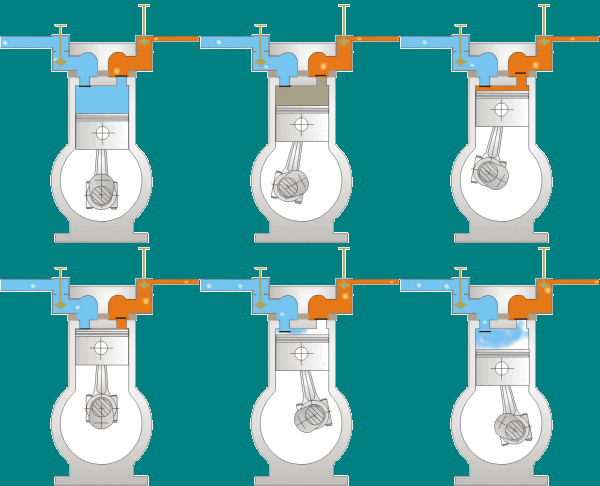
Reciprocating Air compressor is a Mechanical device in which air compression takes place by the action of piston in a cylinder with one way valves and this compressed air is pump into an air chamber.

Types Reciprocating Air compressor:-

1. Single Stage Reciprocating Air compressor.2.Multistage Reciprocating Air compressor.


1.Single Stage Reciprocating Air compressor:-

 A Single Stage Reciprocating Air compressor is a Mechanical device in which Compression of air is takes place in a single stroke or stage.the compressor body is similar to the piston cylinder arrangements.
The compression action is actually carried out by the piston whose motion is to and fro and it's controlled by the crankshaft and connecting road .
Single Stage Reciprocating Air compressor

Working principle:-

In single stage Reciprocating Air compressor, pressure is increased by variation in the volume of air inside the cylinder by means of Reciprocating motion of moving piston.

Construction:-

  • In single stage Reciprocating Air compressor Consists of Piston cylinder arrangements and crank mechanism.
  • There are suction and delivery valves mounted above the head of cylinder.
  • These valves are pressure differential type means that it can open and close automatically by pressure difference inside the cylinder.
  • It has relief Valve so that it can release excess pressurized air when inside the chamber pressure of gas cross  the limit.

Working:-
In single stage Reciprocating Air compressor working is basically done by two stroke that is suction and the other one is compression stroke.
1. Suction Stroke
2. Compression Stroke

1. Suction Stroke:-
   During Suction Stroke the piston starts move first from Top dead center (T.D.C) to Bottom dead center (B.D.C). Now the air compressed in the previous stroke and now when it moves from T.D.C to B.D.C , due to  expansion of air,the entrapped pressurized air in the clearance space  is now decreasing .after some time when the piston is about to reach B.D.C .the pressure of air inside the cylinder falls down below the atmospheric pressure.Due to this the suction valve gets open due to pressure difference .the suction of air continues untill the piston reaches B.D.C. and during this stroke delivery valve remains closed.

2. Compression stroke:-
After completion of Suction Stroke and when the piston starts moving from B.D.C to T.D.C then the pressure of sucked air increasing continues and when it increases above the atmospheric pressure then the suction valve gets closed and due to further movement of piston towards the T.D.C then the compression of air starts and when piston is reach with compressed air along with pressurized air  untill desired discharge pressure obtained.When it obtained desired discharge pressure then delivery valve gets opened and pressurized air is deliver into chamber.and at the end of compression stroke a little bit of pressurized air is entrapped between the clearance space.


2. Multistage Reciprocating Air compressor:-


In multistage Reciprocating Air compressor, between each compression stage the air is passes through a heat exchanger where it is cooled.cooling of air reducing the amount of work Necessary to Compress it further.
              In multistage Compressors,air is cooled in between a stage of Compression with the help of an intercooler.multistage compression feature a series of cylinders,each of a different diameter.


Multistage reciprocating Air compressor


Thank you friends for visit this website.If you like my article then Don't forget to Subscribe and do share with your friends.I Hope you all enjoy it!